I think the best way to review the second generation AirPods Pro is by looking at the three key elements that make any pair of AirPods, well, AirPods. The pods themselves, the case they are stored in, and the overall experience using the pods and case together with other devices.
Starting with the pods themselves, Apple put in a new chip to handle all the new audio features they built for the Pros. The AirPods lineup has had quite a chip journey- starting with the W1 in 2016 before that chipset moved over to the Apple Watch and then the creation of the H1 for all AirPods starting in 2018 to the present day. At this point in time, the H2 chip is only inside the second-generation AirPods Pro. This chip allows Apple to deliver several new audio features like improved noise cancellation and a new Adaptive Transparency mode, but these things aren’t noticeable to me and are not what I’ve come to love about the H2 chip. What I love about the H2 chips is the fact that it allows a constant Bluetooth connection to your iPhone to see the pods battery status no matter where you are in iOS- Lock Screen or Home Screen. It also allows the pods themselves to connect more quickly to my iPhone to resume a podcast or playlist. It’s noticeably improved over previous models of AirPods.
The pods also have an improved touch sensor on the side. Previous generations of AirPods and AirPods Pro have featured a Force Touch surface that can switch between noise cancelation and transparency modes or skip between songs and even summon Siri. But on these new AirPods Pro, the surface is capable of detecting the direction in which you slide your finger across it, up or down, so you can adjust the volume on the fly. This previously would have required you to wear an Apple Watch, pull out your iPhone, or summon Siri and ask her to adjust the volume. But now you can do it directly on the AirPods themselves and it is wonderful.
The final improvement to the pods I want to discuss is the silicon ear tips. The previous AirPods Pro had a small, medium, and large tip option. None of those sizes ever felt right in my ear and they would always pop out making them impossible to wear for a long period of time or while moving my body. The new extra small tip option does fit my ear and has not yet once popped out. It feels wonderful to wear these AirPods Pro for hours at a time.
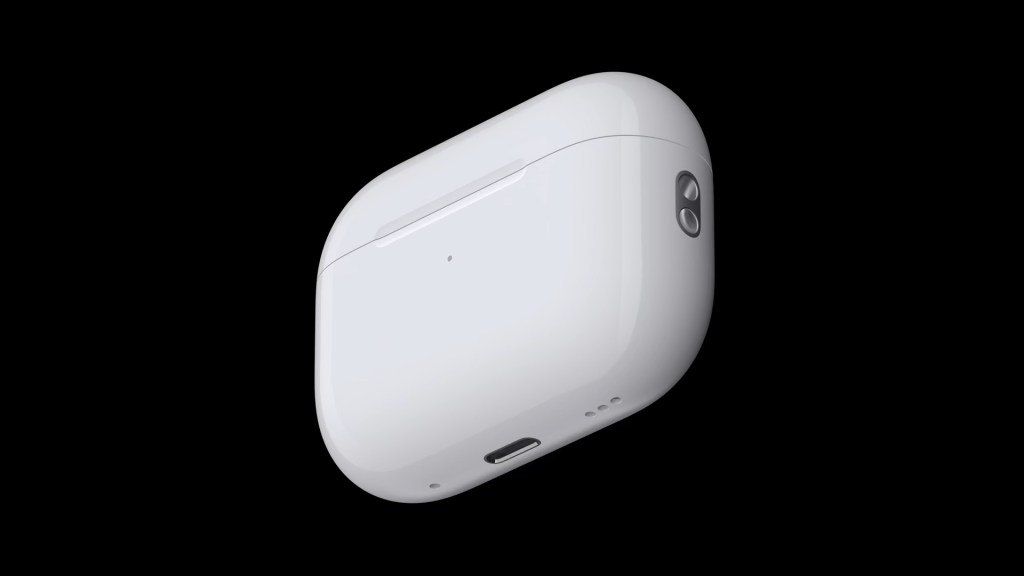
The pods themselves are a solid improvement from the previous AirPods Pro and even the second and third-generation AirPod models, but the case is I think where Apple went the extra mile in making technological and usage improvements. It can be charged by almost any charging method you can imagine. Plugging in a Lightning cable, standard Qi charging, MagSafe puck, and now even the Apple Watch charger can be used. It’s great to have this many options to charge your AirPods!
The case now also features a small speaker to play various tones depending on what you’re doing with the pods. Pairing them for the first time plays a fun pairing tone and placing them on a charger makes Apple’s universally recognized charging sound. When the battery gets low, it also plays a sound for that too. It’s fun. But the bigger deal with the speaker is that it works with the Find My app to basically use your AirPods Pro case as an AirTag.
Opening the Find My app on your iPhone and navigating to your devices and selecting your AirPods Pro case will let you play a sound on them so you can find the case by audio cue. Or, since the case now has the U1 chip inside, the same as an AirTag, it can be precisely located by proximity and your iPhone can guide you directly to it. This suite of features ensures that you cannot lose your expensive new AirPods Pro and acts as a confidence booster to people considering AirPods for the first time as one of the biggest worries people have is centered around losing them.
The only other change they made to the case was the addition of a lanyard loop so you can easily attach your AirPods Pro case to a backpack or your wrist or something. I don’t care about that, but I’m sure others will. The improvements to the case are so good in fact that I think Apple should work to bring all the features of this case to the other AirPods products they make now. Even if it is an extra paid upgrade, I think people would spring for it.
The final component of AirPods Pro is the overall experience of using them. As I have detailed so far in the review, the experience is much improved over previous models. The pairing and setup is as simple as it has ever been but is enhanced by the case’s speaker. The new audio features in the pods themselves I don’t really use or appreciate them, but others I’m sure will or do. And the case adds a huge layer of pleasantness to the overall usability and enjoyment factors of the product. Who knew that a speaker and a single chip could be so transformative?
My only gripes with the AirPods Pro are the fact that it still has a Lightning port on the case rather than the far more ubiquitous USB-C port and the fact that the AirPods Pro doesn’t play well with non-Apple devices and the Mac. Six years in and the Mac still doesn’t have the same seamless setup experience as iPhone does and many features of the AirPods Pro just won’t work if you have an Android device.
The AirPods Pro are expensive at $250, costing the same price as an Apple Watch SE. But if you want the best AirPods money can buy with the most features possible, these are for you. You will absolutely love what they have to offer. If, however, you can’t spend that much on a pair of AirPods and just need some simple-to-use and setup headphones, I’d happily recommend the 3rd generation AirPods. They’re almost as good but at a lower, $180 price and are probably a better fit overall for most people.
 Soul of Apple
Leave a comment